San Agustin Church in Intramuros, Manila was designated as World Heritage Site by UNESCO under classification of "Baroque Churches of the Philippines" together with Nuestra Senora dela Asuncion in Sta. Maria, Ilocos Sur, San Agustin Church in Paoay, Ilocos Norte, and Sto. Tomas de Villanueva Church in Miag-ao, Iloilo. In 1976, it was named as National Historical Landmark by the Philippine Government.
San Agustin Church was the oldest church in the Philippines, construction started in 1586 and completely finished in 1607. The structure was built using adobe stones quarried from Meycauayan, Binangonan and San Mateo. It has an elliptical foundation that keep it strong during earthquakes. San Agustin Church design was derived from churches built by Augustinians in Mexico. The facade is very simple but inside the church has notable baroque architecture. The interior is in the form of Latin cross with ceiling painted in 1875 by Italian artists Cesare Alberoni and Giovanni Dibella. There is a hand-carved 17th-century seats of molave in the choir loft. The church conatains the tomb of Spanish conquistadors Miguel Lopez de Legaspi, Juan de Salcedo and Martin de Goiti and some early Spanish Governors-General and archbishops. Juan Luna, Pedro A. Paterno and Trinidad Pardo de Tavera are among the hundreds whose remains are housed within the church.
The British forces occupied the church 1762 during "Seven Years War". In 1854, it was renovated by architect Lucino Oliver and added two bell towers. It was hit by eartquake in 1880 that makes crack on the left bell tower and eventually it was removed same as it appears in the present. In 1898, the church serve as a place where the Spain prepared the terms of surrender of Manila to the United States following the Spanish-American War. In World War II, the church served as camp for prisoners and during the Battle of Manila, it is the only church inside Intramuros remain standing but the monastery adjascent to the church was totally destroyed. The monastery rebuilt in 1970s by architect Angel Nakpil.
 Image via Wikipedia |
| San Agustin Church Facade |
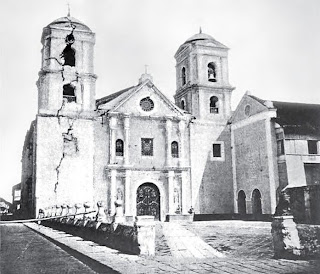 |
Image via Wkipedia
Damage on the left bell tower after 1880 earthquake |
 Image by John T Pilot via Flickr |
| Damaged San Agustin Church during World War 2 |
 Image via Wikipedia |
| Inside San Agustin Church |
 Image via Wikipedia |
| Inside San Agustin Church |
 Image via Wikipedia |
| Wedding Ceremony in San Agustin Church |
 Image via Wikipedia |
| The ornately carved main door of San Agustin Church |

 Image via Wikipedia

 Image via Wikipedia
 Image via Wikipedia
 Image by ~MVI~ (has found pansit in Hyderabad) via Flickr


 Image via Wikipedia
 Image via Wikipedia


